
Is a Linen Hat Worth It? Why Irish Linen, and the Baird McNutt Story

If you are shopping for a linen hat, sooner or later you hit the real question: is a linen hat actually worth it, and is one linen any better than another? I think the answer to both is yes, and I want to show you exactly why. I spent years teaching men how to dress and working with hundreds of brands before I started Vandre, so I have handled a lot of cloth, and after all of it I put one specific linen in every Vandre hat: 100% Irish linen from Baird McNutt, one of the best linen mills in the world.
This is the honest version of what makes a good linen hat worth it: why linen is the fabric to reach for in warm weather, how it stacks up against cotton and straw, what makes high-end Irish linen different, how Irish and Italian linen compare, how to tell the real thing from the loosely labeled version, and why I never source my linen anywhere else. I will keep it practical, because the reasons a good linen hat is worth it are things you can actually feel.
What linen actually is
Linen is made from flax, one of the oldest fibers we have ever cultivated. The flax fiber is long, and that length is the quiet reason linen behaves the way it does. Long fibers spin into a stronger, smoother yarn, which makes linen one of the strongest natural fabrics you can wear. It is stronger than cotton, and unusually, it is even stronger wet than dry. That strength is the foundation of everything people love about linen, because it is what lets the fabric last for years and soften without falling apart.
Flax also has a subtle natural luster, a faint sheen that reads as refined rather than shiny. Two other qualities are worth their own space, because they are among the real reasons to choose linen: the character of its imperfections, and the way it breathes in the heat.
The beauty of the imperfections
Real linen is not perfectly uniform, and that is the point. Look closely at good linen and you will see the occasional slub, a slightly thicker or thinner spot in the yarn, and a gentle variation across the weave. Those are not defects. They are the signature of a natural fiber spun from real flax, and they are one of the first things that separate genuine linen from a flat, machine-perfect synthetic pretending to be it. A fabric with no texture at all, perfectly even and featureless, is usually the tell that it is not really linen, or that it has been blended and finished until the life is pressed out of it.
Those small irregularities are also what give linen its depth. They catch the light unevenly, so the cloth looks made rather than printed, and up close a hat in real linen reads as considered and quietly expensive in a way a uniform fabric never does. Once you know to look for that texture, you notice it everywhere, and you stop wanting the version without it. I do not want a hat that looks like it came out of a mold. I want one that looks woven.

Why linen is the spring and summer hat
Linen breathes better than almost anything you can put on your head. The flax fiber lets air move through the weave, and it takes on and releases moisture quickly, so the cloth does not cling or feel heavy when the heat rises. Textile researchers who study fabric and heat point to the same thing: linen moves moisture away and releases it into the air faster than cotton, and its natural stiffness keeps it from clinging, so air keeps moving around you. That is why linen has been the warm-weather fabric of choice for thousands of years, long before anyone thought to market a performance textile. It simply stays comfortable when it is hot.
It is also light in the hand, and it looks right in exactly the settings summer asks for: a long lunch, travel, an evening out while it is still warm. Vandre is built around the idea that each fabric is chosen with a season in mind, and linen is the one I reach for when the weather turns. It is not locked to summer, hats overlap seasons, but from the first warm week through the end of the heat, the linen hat is the one that earns its place by the door. It is the right hat for the season you are in.
Linen vs cotton vs straw: the best fabric for a summer hat
When people ask what to wear on their head in the heat, the real choice comes down to three fabrics: straw, cotton, and linen. Each has a place, and it helps to be honest about all three.
Straw is the classic sun hat. A good Panama or woven straw is hard to beat for a beach day or wide-brim shade, but it is a specialist. It is not the hat you wear with a polo to lunch or keep by the door for everyday, and it does not come as a refined baseball cap.
Cotton is the versatile everyday choice, and I make no argument against it. My own year-round hat is our Made in USA 100% Organic Cotton line, which is light, comfortable, and goes with just about anything from spring through fall. Cotton is soft from the first wear and endlessly easy to live with. What it does not quite do is breathe the way linen does at the peak of summer, and it does not have linen's crisp, dressed-without-trying character.
Linen is the warm-weather specialist. It breathes better than cotton when it is genuinely hot, it dries faster, and it looks more intentional doing it. For the hottest stretch of the year, or for anyone who wants a summer hat that reads a little more refined, a linen baseball hat is the one. It is not that linen beats cotton at everything. It is that linen is the best fabric for a hat you want to wear when the heat is really on and still look put together.
The one thing linen does that almost nothing else does
Most fabrics are at their best on day one and slowly decline. Linen is the opposite. It is one of the only materials that genuinely improves with age.
Good linen starts with a crisp, structured hand. Then, with every wear and every wash, the fibers relax and the cloth softens, while keeping its strength. It does not thin out, it does not pill, and it does not develop the tired fuzz that makes old cotton feel worn out. It just gets more comfortable and more personal, the way good leather does. A linen piece you buy today can still be in rotation a decade from now, and it will feel better than it did at the start.
This is the heart of the value question. A cheap linen, or a linen cut with synthetic to lower the cost, never gets to have that life. It softens by wearing out rather than breaking in. High-end linen earns its keep by lasting long enough to reward you, and by getting better the whole way through. Measured across the years you will actually own it, the good version is usually the more sensible buy, not the indulgent one.
Built to last, and easy to live with
Because linen is one of the strongest natural fibers, it is forgiving to live with. It resists abrasion, and because it is actually stronger wet than dry, regular washing does not wear it out the way it breaks down weaker fabrics. The fiber holds up to years of use, which is why linen sheets and shirts get handed down through a family. That same durability is why I chose it for a hat, an item that takes real daily wear.
A structured, lined hat asks for a gentler touch than a linen shirt, though. The short version is: clean it by hand in cool water, never machine wash or tumble dry, reshape it, and let it air dry. Treated that way, a linen hat holds its shape and its color for a very long time. I wrote a full, step by step guide to this, including how to relax wrinkles and break the hat in, here: How to Care for an Irish Linen Baseball Hat.
The mill behind the cloth: Baird McNutt
You can talk about linen in the abstract, but in practice the mill matters as much as the fiber. Weaving, dyeing, and finishing are where a good flax fiber becomes a great fabric, or an ordinary one. That is why I do not simply buy “linen.” I buy Baird McNutt.
The story runs deep. The mill traces back to 1798, when the Shankbridge mill was built on the Kellswater river in Antrim, in the north of Ireland. It is one of the oldest working linen mills anywhere, with heritage stretching back more than 220 years. The Baird family business grew through the last century, and later joined with the McNutt family, whose roots are in the design tradition of Donegal, to become the Baird McNutt Irish linen brand that weaves our cloth today.
What I find remarkable is how much of that history is still alive in the work. The mill uses modern looms and modern quality control, but it also still leans on dyeing and finishing knowledge developed in that same works generations ago. Northern Ireland was, for a long stretch of history, the center of the linen world, and that concentration of skill produced a depth of craft that is genuinely hard to replicate now that so few mills remain. Baird McNutt linen turns up in some of the best menswear made today, almost always in shirts and tailoring. Putting it in a baseball hat is the rare, and I think better, use of it. It is the cloth I wanted behind the Vandre name, and I have never had a reason to look elsewhere.

Irish linen versus Italian linen
If you shop for linen at the high end, you will run into two names again and again: Irish and Italian. Both are excellent. Neither is objectively better than the other. They are different tools for different jobs, and understanding the difference explains why I chose the one I did.
Italian linen is prized for a soft, fine, fluid hand. It leans relaxed and drapey, which is why it is a favorite for unstructured summer shirts and easy tailoring. The Italians are masters of finishing, and their linen often feels wonderfully smooth right off the bolt.
Irish linen has a different personality. It tends to be crisper, more substantial, and more structured, with a clean, considered feel that sits on the smart side of casual. It holds its shape. It has a bit of backbone. Historically that structure also made it more resilient and more wrinkle resistant, and it is why Irish linen has long been the choice when you want linen that looks intentional rather than rumpled.
That distinction is the whole reason Irish linen belongs in a Vandre hat. A cap needs to hold a refined, structured shape. It should look considered on your head, not slouchy or shapeless. The soft, fluid quality that makes Italian linen so good for a loose shirt is the opposite of what a well-built cap wants. Irish linen's crisp structure, its durability, and its clean hand are exactly right for a hat meant to look put together and last for years. I did not choose it to be different for its own sake. I chose it because it is the correct cloth for the object.
How to tell if Irish linen is the real thing
Not everything sold as Irish linen is what it sounds like. It is a respected name, so it gets borrowed loosely, and a few things are worth knowing before you spend.
Start with the texture. As covered above, genuine linen has slubs and a little irregularity. A perfectly smooth, uniform fabric is often a blend, or not linen at all.
Be wary of bargain Irish linen. Real Irish linen is not cheap to weave, and a suspiciously low price is usually a sign of a blend or a lower grade of cloth labeled loosely.
Most useful of all, look for a named source. Serious makers will tell you exactly whose linen they use, and they are happy to be asked. Vague language is the warning sign: “linen made in the Irish tradition” or “inspired by Irish linen” is a soft way of saying it is not really from an Irish mill. Genuine Irish linen is never shy about where it comes from.
That last point is why I name Baird McNutt on every linen hat. The fabric is genuine Irish linen, woven by a specific, verifiable mill, and I would rather tell you exactly what is in your hat than hide behind a vague label. I will be just as clear about the rest: the linen is Irish and I name it, and the hat itself is handcrafted overseas to my exact specification. Nothing about that is hidden.
Why Vandre uses only Baird McNutt
Put those threads together, the mill and the character, and you have the reason our linen never varies.
I want one standard, held consistently, so a Vandre linen hat feels the same whether you buy it this summer or three summers from now. Baird McNutt gives me that: a 100% Irish linen with the structure and hand a refined cap needs, woven by a mill with more than two centuries of craft behind it and the quality control to deliver it the same way every time. The provenance is real and it is nameable, so I can tell you exactly whose cloth is on your head, which is not something most hat brands can or will do.
There is a positioning point here too, and I will be straight about it. Vandre is the grown-up baseball cap, built for the man who has outgrown loud, logo-covered caps. The only branding on our linen hat is a single embroidered V. In place of a logo, the proof is the cloth: 100% Irish linen, woven by Baird McNutt, finished with details borrowed from fine tailoring, and kept in a satin bag. That is what luxury without the logo actually looks like. The value is in the material and the making, not in a badge.
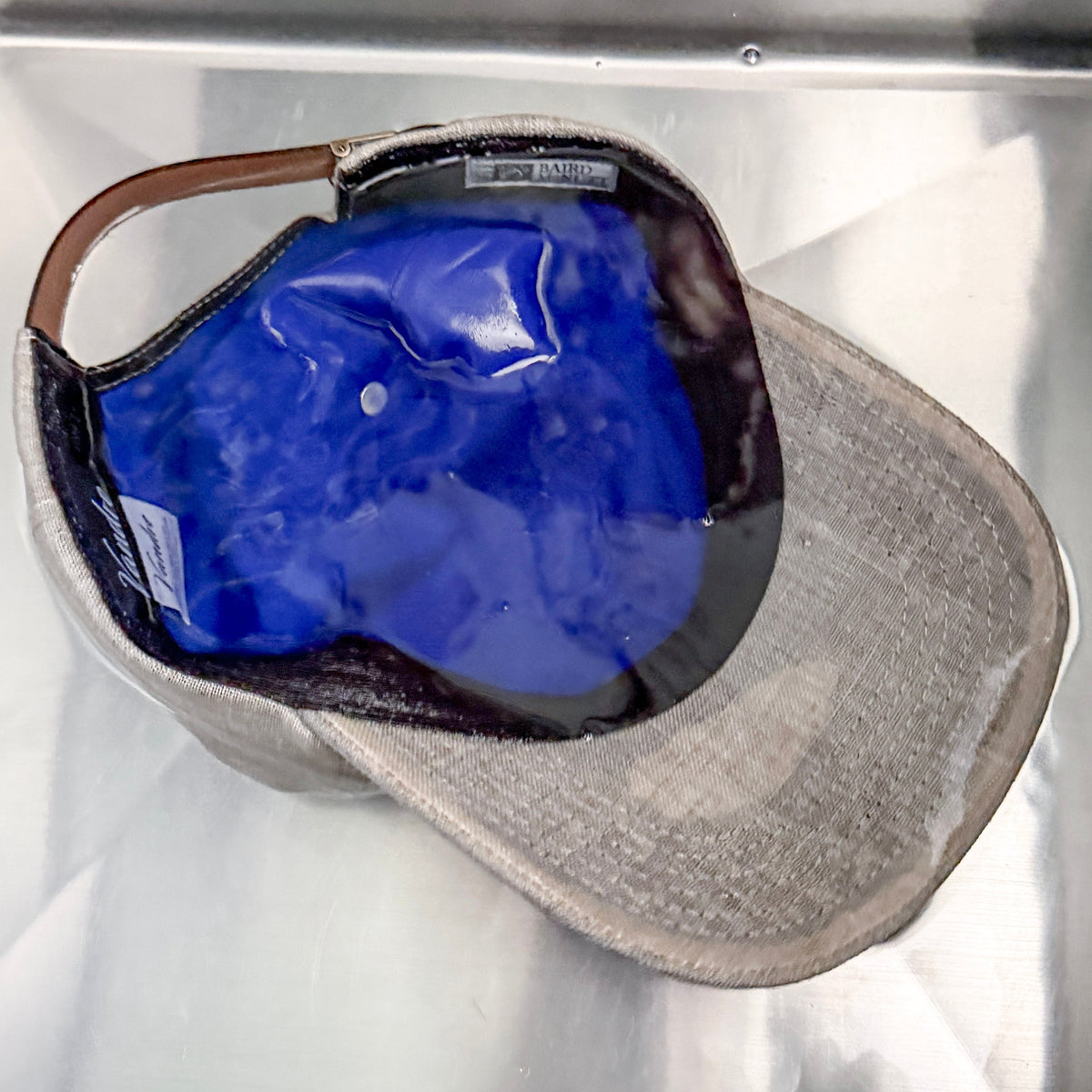
To be clear about what the hat is: the shell is 100% Irish linen, and the hat is fully lined so it holds its shape and finishes cleanly. It is a structured, refined baseball hat designed for warmer weather, in Arashi Sand, Navy Blue, and Slate Gray. The fiber and the mill are Irish, and I am proud to name them. The hat itself is designed in Chicago, then handcrafted overseas to a standard I set and check myself.
100% Irish linen, woven by Baird McNutt, and handcrafted overseas to my exact specification.
So, is good Irish linen worth the money?
If you only wear a hat a handful of times, almost anything will do. But if you want one you actually reach for, that looks refined, breathes in the heat, softens into something personal, and still looks right years from now, then yes, good Irish linen is worth every bit of what it costs. The price buys longevity, comfort that grows, and the quiet confidence of a material with real provenance behind it. Spread across the years you will own it, high-end Irish linen is not the expensive choice. It is the lasting one.
If you want to see it in person, you can shop the Irish linen hats here. If you would like the bigger picture on how the whole brand is built around cloth, I wrote about that in A Return to Fabric. And once you have one, here is how to wear a linen baseball cap.
Timeless Headwear. Designed with Intention.
Ben / Dapper Professional
Frequently asked questions
Is Irish linen worth it?
Yes, if you want something that lasts and improves with age. Irish linen is one of the strongest natural fabrics, it softens with every wear instead of wearing out, and it can stay in rotation for years. Measured by cost per wear over that lifespan, good Irish linen is usually the sensible choice, not the indulgent one.
Are linen hats good?
Yes. Linen is one of the best fabrics for a warm-weather hat because it breathes well, stays comfortable as the heat climbs, and softens with wear instead of wearing out. A well-made linen hat also holds a refined shape and lasts for years.
Is a linen hat good for summer?
Very. Linen breathes better than most fabrics, takes on and releases moisture quickly so it does not cling, and feels light on your head, which is why it has been the warm-weather choice for thousands of years.
Is linen or cotton better for a summer hat?
Both are good. Cotton is the more versatile year-round option and is soft from the first wear. Linen breathes better at the height of summer, dries faster, and looks a little more refined, so it is the better pick for the hottest days or a dressier warm-weather look.
Is Irish linen good for a hat?
Yes, and it is one of the best choices there is. Irish linen is crisp, structured, and durable, so it holds a refined shape rather than going slouchy, and it breathes beautifully in warm weather. Those are exactly the qualities a well-made baseball hat needs.
What is the difference between Irish linen and Italian linen?
Italian linen tends to be softer and more fluid, which suits relaxed shirts. Irish linen tends to be crisper, more substantial, and more structured, which is why it is the better choice for a refined, shape-holding cap. Both are high-end. Neither is better overall. They are made for different uses.
What is Baird McNutt linen?
Baird McNutt is one of the best and oldest Irish linen mills, with roots going back to 1798 on the Kellswater river in Antrim. It weaves the 100% Irish linen used in every Vandre linen hat, combining more than two centuries of craft with modern quality control.
How can I tell if Irish linen is genuine?
Look for texture, price, and a named source. Real linen has slubs and slight irregularity, genuine Irish linen is not cheap, and a trustworthy maker will tell you exactly which mill wove it. Vague phrases like “inspired by Irish linen” usually mean it is not from an Irish mill.
Why does my linen hat have slubs or an uneven texture?
Those small irregularities, called slubs, are a hallmark of genuine linen, not a defect. They come from the natural flax fiber and give the cloth its depth and character. A perfectly uniform texture is usually a sign a fabric is synthetic or heavily blended.
Does linen get softer over time?
Yes, and this is one of its best qualities. Linen starts crisp and softens with every wear and wash while keeping its strength, so it becomes more comfortable the longer you own it, without pilling or wearing thin.
How do I care for a linen baseball hat?
Hand wash gently in cool water, reshape, and air dry. Never machine wash or tumble dry a structured, lined hat. The full step by step, including relaxing wrinkles and breaking it in, is in our guide, How to Care for an Irish Linen Baseball Hat.
Where is the Vandre linen hat made?
The 100% Irish linen is woven by the Baird McNutt mill. The hat is designed in Chicago and handcrafted overseas to my exact specification.